
What Exactly Is the President’s Cabinet?
By Scott Burton Official for TrumpTrain.net (6 min read)

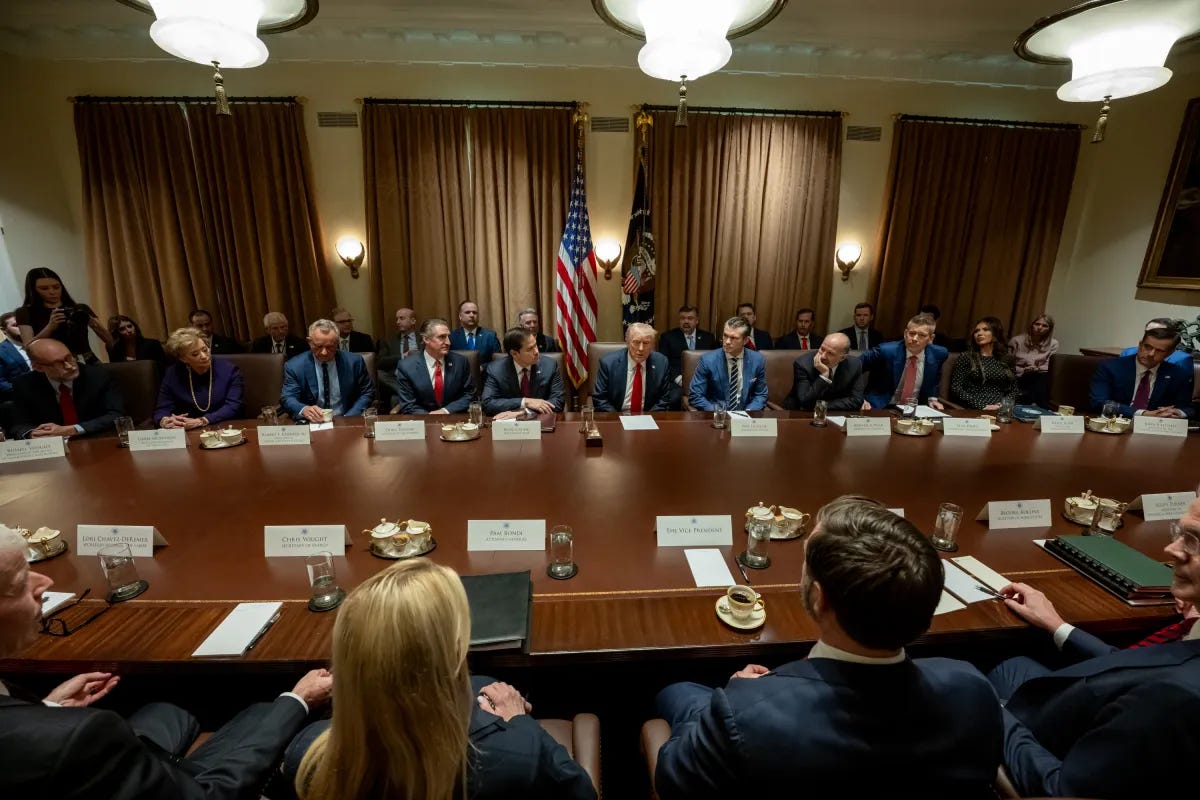
WASHINGTON – The group of officials who sat with President Donald Trump for the final Cabinet meeting of 2025 on Dec. 2 is known simply as the Cabinet. It is the president’s principal advisory body on executive policy and the leadership team for the 15 major departments of the federal government.
Constitutional Origin
The Cabinet is not mentioned by name in the Constitution. Its existence rests on a single sentence in Article II, Section 2, which allows the president to “require the Opinion, in writing, of the principal Officer in each of the executive Departments, upon any Subject relating to the Duties of their respective Offices.
”From that brief clause has grown an institution that has operated continuously since 1789.
The First Cabinet Under Washington
President George Washington began the practice in 1791 when he started meeting regularly with his four department heads: Secretary of State Thomas Jefferson, Secretary of the Treasury Alexander Hamilton, Secretary of War Henry Knox, and Attorney General Edmund Randolph.Washington called them “heads of departments.” The term “Cabinet” was borrowed from the small private rooms where British monarchs met their closest advisers, and the name stuck. By the end of Washington’s second term the four were meeting as a group about twice a month. Every president since has followed the practice.
Growth of the Cabinet
Congress created new departments as the nation expanded. The Navy Department was established in 1798, Interior in 1849, Agriculture in 1889, Commerce and Labor in 1903 (split into two departments in 1913), Defense in 1947 when the War and Navy departments merged, Health, Education and Welfare in 1953 (later split), Housing and Urban Development in 1965, Transportation in 1966, Energy in 1977, Education in 1979, Veterans Affairs in 1989, and Homeland Security in 2002.
These 15 executive departments form the core of the modern Cabinet. Their heads are appointed by the president and confirmed by the Senate.
Cabinet-Rank Officials
By law or tradition, certain other officials also attend Cabinet meetings with Cabinet rank. In the current administration these include the vice president, the White House chief of staff, the U.S. trade representative, the administrator of the Environmental Protection Agency, the director of the Office of Management and Budget, the director of national intelligence, the ambassador to the United Nations, and the administrator of the Small Business Administration.
Legal Authority and Limits
The Cabinet has no collective legal authority. It cannot vote, issue orders, or overrule the president. Its only power is to advise. Presidents may consult the full Cabinet, smaller groups, or individual members as they see fit.
Some presidents have met the full Cabinet weekly; others only a handful of times per term.
Day-to-Day Role
Cabinet secretaries serve as the chief operating officers of their departments. They manage budgets that together account for roughly three-quarters of all federal spending and supervise more than 4 million civilian employees. They issue regulations, execute laws passed by Congress, represent the United States abroad within their portfolios, and testify before congressional committees.
The Cabinet Room
The Cabinet meets in the Cabinet Room on the first floor of the West Wing, directly across the hall from the Oval Office. The room has been in continuous use for the purpose since 1909.
Meeting Format Under Trump
In the Trump administration the typical full Cabinet meeting begins with remarks from the president, proceeds to short updates from each member, and sometimes ends with questions from reporters.
Historical Evolution
The Cabinet’s role has changed with the presidency itself. Early presidents used it for genuine deliberation. Later presidents have treated it more as a coordinating body or, occasionally, as a public display of administration unity.Regardless of style, the fundamental arrangement remains the same as it was in 1791: the heads of the great executive departments meet at the call of the president to offer advice and to carry out his policies.